What is a rollup?
KLEAR3 EditorialPublished Updated
A rollup is a blockchain that executes transactions on its own, away from the main chain, then posts the compressed result back to that chain. Ethereum keeps the record and settles disputes; the rollup does the work. The word describes this architecture, and it promises nothing about how much you have to trust whoever runs it.
What a rollup is
A separate chain that borrows the security of the main one instead of building its own.
A blockchain is slow because every participant re-executes every transaction. That repetition is what makes it hard to cheat, and it is also what caps its throughput. A rollup breaks the trade-off by moving execution somewhere else: it runs the transactions itself, batches them, and writes the outcome to Ethereum along with enough information for anyone to challenge it.
What Ethereum stores is no longer every transaction, but the proof that a batch of them was processed correctly. The rollup carries the cost of doing the work; the main chain carries the cost of remembering it.
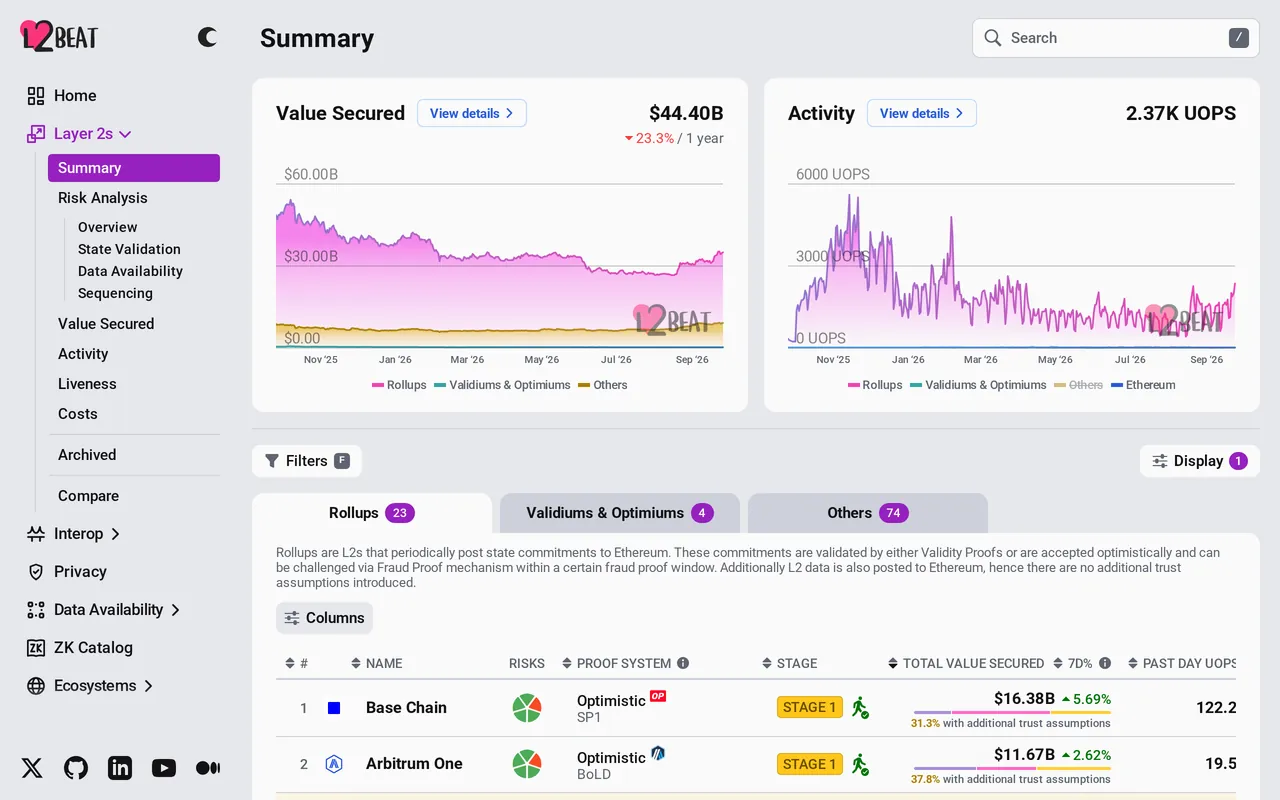
Networks that run this way, among those covered on this site:
What happens to one transaction
- 1You send it to the rollupnot to Ethereum
- 2The rollup executes and batches itwith thousands of others
- 3The batch is posted to Ethereumcompressed, with its data
- 4Anyone can recompute the resultand challenge it if it is wrong
The two families
Optimistic rollups assume the result is right and allow challenges. Zero-knowledge rollups prove it up front.
An optimistic rollup posts its result and opens a window during which anyone can submit a fraud proof. Nothing is verified unless someone objects, which makes it cheap to run and slow to exit: the window has to close before a withdrawal is final.
A zero-knowledge rollup attaches a cryptographic proof that the batch was computed correctly. Ethereum checks the proof rather than the work, so nobody needs to be watching for the result to hold, and withdrawals do not wait on a challenge window. The proof is expensive to produce, which is the trade.
What the word does not promise
Of the 22 rollups on Ethereum, 4 have reached the stage where users can exit without the operator.
Most rollups running today keep an emergency lever: a small group, sometimes a single key, that can upgrade the contracts or pause withdrawals. That lever exists for good reasons, since a bug in a young system can drain it in minutes. It also means your ability to get your funds out depends on people rather than on code.
L2BEAT grades exactly this, from Stage 0 where the operators hold the levers, to Stage 2 where the contracts are governed by proofs and users can leave whatever the team does. Read on 26 September 2026, 12 of the 22 rollups sat at Stage 0 and 4 at Stage 2. The word “rollup” is true of all of them, which is why it settles nothing on its own.
Counts read from L2BEAT, GET https://l2beat.com/api/scaling/summary, on 2026-09-26. L2BEAT publishes its criteria and is not the projects it grades, which makes it a third party rather than a primary source: we did not re-measure the contracts ourselves.
Frequently asked questions
Is a rollup the same thing as a sidechain?
No, and the difference is the one that matters when something goes wrong. A sidechain runs on its own security: it has its own validators, its own rules, and if that set of validators colludes or fails, nothing on Ethereum protects the funds sitting there. A rollup posts its data back to Ethereum, so the record of what happened lives on a chain it does not control, and anyone can rebuild the rollup state from it. That is the whole point of the design. In practice many networks marketed as layer 2 are closer to sidechains, because they publish only summaries rather than the data needed to reconstruct their state. The published category is what tells you which one you are actually using.
Why do withdrawals from some rollups take a week?
Because an optimistic rollup assumes its own result is correct and gives everyone else a window to prove otherwise. Until that window closes, the withdrawal is not final on Ethereum, and the usual length is seven days. It is not a technical slowness but a deliberate delay: it is the time granted to whoever wants to submit a fraud proof. Zero-knowledge rollups do not need it, since the proof travels with the batch and Ethereum verifies it immediately. Bridges advertising instant withdrawals from optimistic rollups are not removing the delay, they are advancing you the funds and taking the wait, and the counterparty risk, on themselves. That service has a price and a provider, both worth knowing before using it.
How do I know whether a given rollup is safe to use?
Look at who can change the contracts and who can stop a withdrawal, rather than at the marketing. Three questions cover most of it: can a small group upgrade the system without delay, is the data needed to rebuild your balance actually published on Ethereum, and can you exit if the team disappears tomorrow. L2BEAT answers all three per project through its stages, which is why we cite them here rather than restating a general claim. A Stage 0 rollup is not necessarily dangerous, and plenty of serious projects sit there while they mature. It does mean that using it is a bet on the operators as much as on the cryptography, and that is a different decision from the one the word suggests.
Ask an assistant to summarise it and check what it claims.